






















Transcript of a conversation with Marina Abramović and Maria Balshaw

Participants

MA = Marina Abramović
MB = Maria Balshaw

Recording starts

MB: So Marina Abramović, you are here in Manchester, finally!

MA: Yes.

MB: Tell me a little bit about the artists we’re going to see outside, in the gallery spaces.

MA: It was quite a time , including you and Hans Ulrich, thinking about what different artists, so let’s start with the youngest one, Terence Koh, who is born 1980, which is amazingly young.

MB: Yes, makes me feel so old!

MA: [Laughs] So ancient!. And so he is a Canadian Chinese artist living in New York and decided because he’d never done a long durational performance work before that we would commission one from him and is like the really huge task, and he’s the one who, when you come to the entrance, the first thing you can see. Then we have Nikhil Chopra, the Indian artist who Hans Ulrich discovered on his recent trip from India …
MB: And he’s very young too, isn’t he? 1977 I think.
MA: He is also really young, and I was not aware of his activities and what he’s doing now, like really he’s actually one of the artists who’s doing process performance, which actually presents the process, and how it was developing from there, just packing the gallery first so wonderfully; he was very happy with that.

MB: Absolutely. Well, he’s drawing onto the walls and the floor and almost up onto the ceilings, and to me it’s just extraordinary to watch the gallery space change.

MA: And Chopra likes so much that kind of ritual that he’s doing with his lunghi, the typical Indian little scarf around his belly; and then he goes through this, at the end of the day, through his process of ritual washing, and taking these different personalities which he is posing, and with his costumes so carefully packaged that stay on the ground. And then every end of the day it’s like a public procession through the gallery that come together to see the portrait on the end, which really gives the kind of ‘finishing’ to the entire performance event every night.

MB: Some work is process, some is image, some is interaction.

MA: Exactly. But it’s very interesting how when all the artists come together, how there is a certain rhythm of this four hours that it takes place and how things are interacting. So first time when you enter through the Amanda Coogan space, which is the Irish artist who is doing this repeated jump in the loop, you are waiting for this jump and finally the jump comes, sometimes you miss it, but then wherever you are in the space, you can hear this release of this emotion, ‘Raaah … raaah’ and you know, anywhere you are, that she actually jumped. And the same thing happened with Nico Vascellari, the young Italian artist who chose such an, in a way, unattractive space thinking about just the basement of a staircase.

MB: Yes, down in the basement of the gallery.

MA: Where no one ever goes because it’s a part of the office space here, but then he’s doing this bell …… the hitting sound of the stone and creating again a certain sound and rhythm it gives to everything else.

And I don’t know if you’re aware but this is very interesting what the artist told me, that Ivan Civic, who the next young artist after Terence, who make this work which is actually the only video we use and I think one of the best ways of using video. And his interaction with the video going back to his home place, Sarajevo, after the bombing, is that exactly twenty minutes before the end comes this song when he’s visiting a graveyard. So everybody hears this in all the other spaces and knew, ‘Oh, now it’s twenty minutes more.’ It is funny how the time, actually you start being aware of time even through the work of another person.

MB: The fifteen different artists have become a whole.

MA: Exactly.

MB: But it is a whole exhibition and it takes place over the whole gallery. But it needs the collection to have gone. So tell me about how you came to realise that that needed to happen?

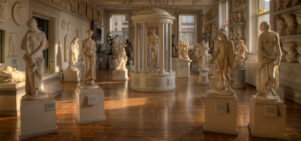
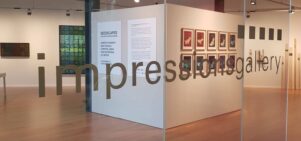
MA: You know, it was really something that Hans and me we work around when we came here to Manchester first time to visit. And there was so much work there and you have the textile collection, you have the sculptures, you have the paintings, you have so many things, and it’s like a normal museum. And then I was thinking if something radical and new have to take place, something else have to go in order to make this space, and this was we were so afraid, you know, to …… somehow we both said the same, click, you know, ‘Can you imagine this space empty?’ And it was like after this we could not imagine anywhere else. And then of course it took us a lot of courage to tell you that!

MB: [Laughs] But for me it was very funny that you were scared to ask me.

MA: Well, you’re director of this place and it’s not easy to ask anybody. I’ve never done this in my life till now to say, ‘Excuse me – can you empty everything from the collection, put somewhere else and we have empty space?’ [Laughter] I think that why it’s so successful at the moment is because of that radicality and because of this that you understood in the same second what that means, and that’s why it’s like this.

MB: Well, you had a word for it in your drill. You said it’s about making the holy ground.

MA: Yeah.

MB: And it’s about giving space for this kind of art.

MA: And to me, it’s so interesting that also the Manchester public who comes to this gallery and comes to know the exhibition, know the collection, comes and find themselves in the same space but a completely new. So it’s like that means that we should raise the question; how is it possible that one institution actually has this kind of transformation? And it’s actually possible.

MB: How to really engage people. But you do some of that work with your drill, so just talk for a minute about the importance of that first hour for the public.

MA: When you made this kind of heroic act to empty the gallery and make this effort, which is a huge effort, I was thinking I have to make the same effort. I have to really be an entire period of time here, seventy days, and make this pubic drill to really see if this thing can function. And I think without public drill, it would not function the same way, because we will again have this public who come for short and go. They have to stay the same amount of time as the artists that are doing the performance, so there’s a kind of equality in the energy input.

MB: Many people who know your work, your career, are coming and expecting something violent and extreme. But you take the opposite position and what you give them is something that is gentle and intimate and it slows everybody down.

MA: I would never do anything aggressive to the public. If I’m doing something, this is what I’m taking more specifically upon myself. But here the entire idea of this show is to slow down the public and to kind of centre them in order they can receive something else.

MB: Because you make people look at each other in the drill, that reminds them that they have to really look at the artists’ work, so it prepares them to spend time looking.

MA: The art is really about looking and, of course, experience emotionally and on every other level but looking, and we have to really learn to do that and people don’t look each other in the eyes; they don’t. They just kind of …

But you see Maria, for me as for you, this is really such a …… the first experience to do that. So it’s really interesting for me now that this is finishing, the collection is coming back and then it becomes completely different. How do you feel about this whole thing and what will be your next step, having this experience as you’re having it now?

MB: What we’ve experienced is changing all of us.

MA: And we are not even half through.

MB: Absolutely. And I think it’s changed all the staff here because they have all been part of making it possible, and we’re seeing the building completely differently. So the collection will come back but it won’t, it can’t be the same again. Nico’s noise echoes through the gallery as if we are knocking the Whitworth down, and to me that is what we’re doing, to build it back up again and work with the public in a different kind of way and to see the collection that we have with completely new eyes. So for me, the encounter with you and all the other artists is about learning how to look at our collection. It makes it brand new again.

MA: And I think to conclude this conversation, for me what is the most experience we are going through, both of us, is actually how to deal with the public in a new way.

MB: Absolutely.

MA: That’s where we are getting to.

MB: I think that’s the most significant thing. I’ve seen people come out at the end and they are euphoric and many of them say, ‘I thought I would only be able to stay for two hours but this hasn’t been long enough.’

MA: [Laughs]

MB: And that to me is the triumph.

MA: And that’s the way, not to see only performance, but that’s the way to see art in general, to spend time.

MB: Absolutely.

Recording ends 9:50

  • Join our club
    Creative Tourist Boutique
  • Your top-to-bottom guide to Manchester
    The Manchester Cultural Calendar 2011
    • Boutique Weekender: February 2012

      Mark the start of spring with this very special, pick n’ mix weekend of art, music, dance and fashion

    • History lesson.

      Visiting Manchester? Want to find out more about what makes Manchester (and Mancunians) tick? Look no further than our potted guide to Manchester past and present. Susie Stubbs and Jonathan Schofield tell all.

    • Curiouser and curiouser.

      Susie Stubbs gets confused and amused at Tate Liverpool’s latest exhibition, Alice in Wonderland

  • Creative Tourist iPhone app
    Creative Tourist iPhone app
  • Manchester hotels
    Book your stay
  • A playful trip around the city
    Manchester Mini Explorer pack
  • Explore Manchester
    The Manchester Weekender 2012
  • Manchester Cultural Calendar
    The Manchester Cultural Calendar 2012
  • Find out more
    Join our mailing list
  • Competitions
    Win stuff now!
  • Goseethis.com
  • Flickr Photostream
    Up, Up, And AwayWhat You Laughing AtWe Love ManchesterAfterHours - BlackLab (03)AfterHours - BlackLab (04)AfterHours - BlackLab (01)