















Interview with Leo Fitzmaurice (transcript)

Participants
LF = Leo Fitzmaurice
EO = Elisa Oliver

Recording starts
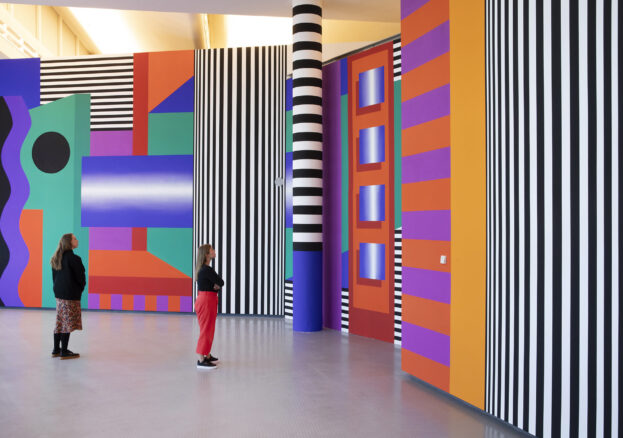
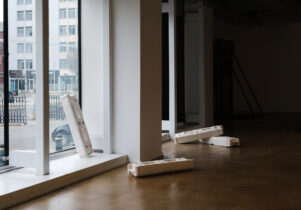
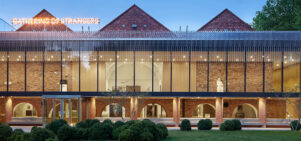
LF: For this commission, I think to focus purely on the architecture is really important for me and to heighten it in a way, and to celebrate it as well because it is a genuinely inspirational space. And probably a space that I’ve never seen anywhere else, certainly in Europe, and I can’t think offhand of anywhere else in the world that’s got the particularity of this architecture to work with, so it’s quite exciting.

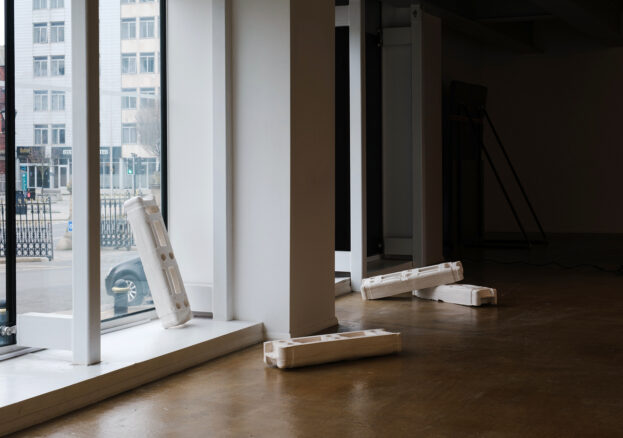
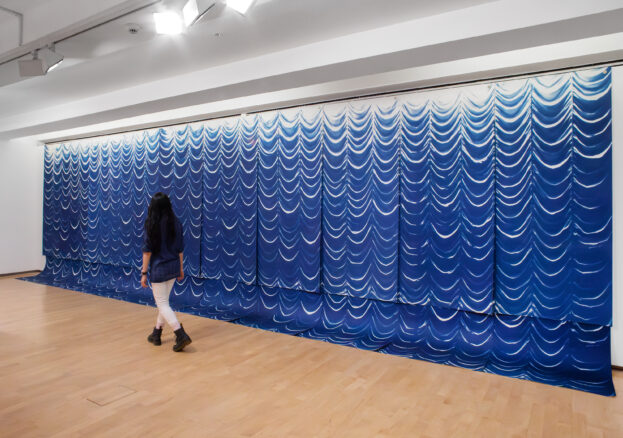
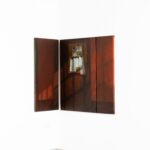
So I quite like the idea of using the film boxes which are now quite redundant and then effectively making giant paintings of them in the space; especially in relation to MediaCity Studios over there. So you’ve got redundant media figured in the gallery overlooking the cutting edge media across the dock.

I guess going right back, my whole knowledge about art history was taken from glossy magazines, and I think that’s profoundly affected my understanding about fine art in some ways. But through that kind of development of my knowledge about the subject, I started to become interested in the actual containers of information themselves rather than necessarily the information that they were showing.

EO: So the objects are very familiar, can you tell us a little bit more about that, about your interest in their familiarity, because they’re drawn from things that we’re all very aware of but your transformation does something very ‘other’ to them.

LF: Yes, I think the materials that I use now moving forward are things that are absolutely everywhere around us. So it’s mainly packaging, advertising materials, brochures – it’s basically the stuff that most impinges on us visually. So it could be anything from sort of flyers or billboard adverts to Argos shopping catalogues, things like that. So those are my starting points and they’re things that I guess are most often overlooked, because people pick them up to direct them somewhere else, to direct them to something else that they’re going to buy, which they consider as an object. So you might get the Argos catalogue and it directs you to probably hundreds of thousands, probably at least thousands of objects that you’re then going to buy and you’re then going to say, ‘this is the thing that I want,’ and the Argos catalogue is the thing that kind of gets you there. But when you actually look at the object itself, which I am now actually, basically it’s a phenomenally condensed piece of information object; and it’s that kind of interface, information object that is really quite essential to the practice.

EO: So on that basis, you talked about a lot of them being objects that are very every day, that are things that we encounter in a particular way, and you’re drawing attention back to them as objects really, rather than as necessarily carriers of information.

LF: Yes, I mean as I say, they absolutely don’t notice them at all, and yet they have an incredible amount of attention and energy put into designing them for us to buy them. So it’s partly directing people back to that, but it’s also partly getting them to look at something that they’re part of, because actually the reason why all this design exists is because it attracts us, and by our choices we actually take part in the process of what’s around us. So if we don’t pick something up, whether it’s a product or a brochure or a catalogue, a flyer, or whatever, or we don’t buy the product that’s advertised on a certain billboard, then it ceases to be important and it’ll fall out of use.

I think in every case I’ve probably used quite basic techniques. I mean with some work, I alter things by just cutting writing off it, or other times I obliterate writing with a felt tip pen, and it’s something that we can all do and it’s an incredibly cheap way of altering the world around us. And for me it’s a bit like wanting to own this stuff more than just buying it. I think it just seems a very superficial way of interacting with this sort of material, or even the world in general, is to just say, ‘I bought it, therefore I’ve got a relationship with it.’ By actually physically manipulating it and touching it and cutting it and bending it and reforming it, you actually develop a much deeper relationship with all of this stuff that’s around you. And you almost, not defuse it but yes, it stops becoming something that’s kind of attacking you and you can just… When I say attacking, that’s probably a bit of a strong word, it stops impinging on you and demanding your attention, and it starts to become something of your own that you can kind of pick up and enjoy in your own time and space and on your own terms.

EO: So how did you first start working in this particular way? Can you remember the first time you cut a bit of text off an object or altered something with felt tip?

LF: Yes, very much so. I guess probably the felt tip thing would go way back when, it’s almost like a sort of delinquent schoolboy kind of activity, so there’s that. But the actual specific one that I’ve carried out quite a lot since, which is cutting blocks of text out, it’s almost like as the designer puts the blocks in, I’ve cut the blocks out. I started doing that in the tower block in the project that I was doing in Liverpool which was called Further Up In The Air. And I won’t go into too much detail, but it was an ongoing project where artists came and lived and worked in a soon to be demolished tower block, and they all had studio spaces. But I went round lots of the empty flats – well, actually they said they were empty, but a lot of the flats had old packaging material in.

And I was working on the thirteenth floor and had this view over the city, and I don’t know how it happened, but I thought I just want to see what that box looks like without writing on it. And as soon as I’d done it, I just cut the text out and that looks like a piece of architecture. And from there I build a complete cityscape and sited it in one of the flats that was overlooking the city. So it was almost like a model version of what was outside. But from that point on I just got this real interest in cutting text out, and I became quite respectful in some way of the graphic designer. And also realised how many connections it had got with earlier periods in art history, along with architecture, and that these two things had developed alongside each other over the last hundred years.

EO: So given that the work can be quite specific in terms of the foul materials and the type of materials that you’re working with, how do you feel your work’s responded to a very specific commission and working with a very specific space, when quite often you’re working with stuff that you might discover in the street or you’re working quite often with juxtaposition and chance.
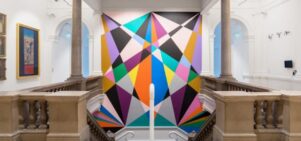
LF: Yeah. Over the last few years I seem to sort of categorise things on a sliding scale. I mean something like a public art commission has an incredibly tight brief and a series of conditions almost that you have to respond to. It almost in some ways designs the work. And then at the other end of the scale, you’ve got studio work where I suppose you could say it’s like blue sky thinking; you can just go anywhere you want. Looking at my work generally, I would say that’s kind of where it all starts, or when I’m out and going for a walk, I just get an observation and think, that’s a wonderful little situation or moment. So that’s completely untrammelled by any other agendas. The Lowry Commission’s completely in the middle in some ways. The exciting thing is that basically you’ve got the space, just go and do something with it. And that’s the thing I found most exciting. And certainly for the actual commission itself, there wasn’t that many parameters, or the fact that I had to respond to the space, respond to the architecture, and that’s something that I immediately did. So it was quite exciting and I think it’s going to be useful from that point of view for my practice.
This is our shared language, this is our shared culture, more than art really, a lot more than art; art’s a sort of side argument in some way. And it does feed back into culture, because a lot of designers go round galleries, and a lot of new design comes from art. But the actual big mass debate happens when people buy something and by buying it, they’re showing approval for it. And that manifests itself in so many ways. Like I got a piece where I basically collected cans and they faded to white, but there’s a slightly long story attached to that. And when I was a courier I had a job to deliver four of these cans to Glasgow one night on my motorbike, and it was in the winter. And there were four slightly different coloured reds on these coke cans, they were empty cans of coke and they would go into a metal box, and the guy there at the canning plant had to pick the one that was exactly the right coke red, because if it wasn’t then the sales would go down.
So this is a language that exists, so everything that I do taps into that energy and they’re things that are perhaps attached to something in our head. They’re things that we believe in as a group of people and I use the original energy of the design, and then by removing its function can push it in another direction but we can enjoy it in a whole new way. I kind of think of it like one of those science fiction films when there’s this meteorite heading towards the planet, and if you hit it at just the right point it’ll just go off into a completely different orbit. So you actually need a very small energy to shift a very large fast moving object, which is what I think of as this whole plethora of media heading at my head.

Recording ends

  • Join our club
    Creative Tourist Boutique
  • Your top-to-bottom guide to Manchester
    The Manchester Cultural Calendar 2011
    • Boutique Weekender: February 2012

      Mark the start of spring with this very special, pick n’ mix weekend of art, music, dance and fashion

    • History lesson.

      Visiting Manchester? Want to find out more about what makes Manchester (and Mancunians) tick? Look no further than our potted guide to Manchester past and present. Susie Stubbs and Jonathan Schofield tell all.

    • Curiouser and curiouser.

      Susie Stubbs gets confused and amused at Tate Liverpool’s latest exhibition, Alice in Wonderland

  • Creative Tourist iPhone app
    Creative Tourist iPhone app
  • Manchester hotels
    Book your stay
  • A playful trip around the city
    Manchester Mini Explorer pack
  • Explore Manchester
    The Manchester Weekender 2012
  • Manchester Cultural Calendar
    The Manchester Cultural Calendar 2012
  • Find out more
    Join our mailing list
  • Competitions
    Win stuff now!
  • Goseethis.com
  • Flickr Photostream
    Up, Up, And AwayWhat You Laughing AtWe Love ManchesterAfterHours - BlackLab (03)AfterHours - BlackLab (04)AfterHours - BlackLab (01)