



















There Will Be Blood in concert at The Bridgewater Hall
Johnny James, Managing Editor
Book now
There Will Be Blood in concert
Always double check opening hours with the venue before making a special visit.
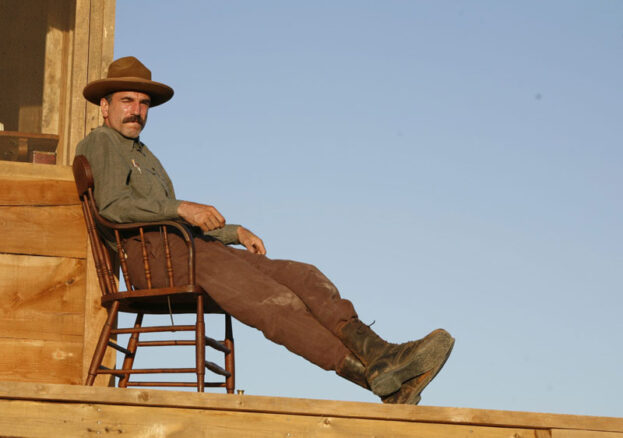
Jonny Greenwood can’t sing. No matter. He’s got the ondes Martenot, the eerie electronic instrument he’s played since his teens. “There’s nothing closer”, he’s said. “It makes the theremin look like a toy”. Tonight, he plays it live, alongside the Hallé, for the score that opened a new chapter for him as a composer.
There Will Be Blood was Greenwood’s first film score, but its success wasn’t beginner’s luck. He’d already spent years as composer-in-residence with the BBC Concert Orchestra, steeped in Messiaen and Penderecki, before Paul Thomas Anderson came calling. Asked about his process, Greenwood described chasing “the underlying menace in the film, the greed” rather than writing conventional character themes – closer to how a concert composer thinks than how Hollywood usually operates.
The film opens without a word of dialogue – just Daniel Plainview alone underground, hacking at rock – scored with howling dread that critics have compared to the ‘Dawn of Man’ sequence that opens Kubrick’s 2001. Greenwood builds that dread technically: sighing pairs of spacious chords give way to motoric, propulsive rhythms, with the strings sometimes divided into nearly two dozen separate lines, stacking into dense, unresolved clusters.
This is not music that’s content to sit in the background, but Anderson’s films have never asked that of their soundtracks. This one really pushed that principle, though; the Guardian called it “so strange it almost seems to have been delivered here from another planet”, while also saying the film’s “lowering, psychotic atmosphere” owes as much to Greenwood as to Daniel Day-Lewis.
The score was so thoroughly Greenwood’s own that it caused a problem: nominated for an Academy Award, it was disqualified for reusing material from his earlier concert pieces, Popcorn Superhet Receiver and Smear. Not exactly a criticism – more proof that Greenwood wasn’t writing film music so much as continuing a body of work. Fans and critics, though, were furious, and in a way that measures the quality of the art more than a nod from the Academy ever could.
For anyone who spent the earlier part of the day at Manchester Cathedral for 606 Years of Reverb, it’s the same composer in a completely different register (and still not a guitar in sight). Conducted by Hugh Tieppo-Brunt, tonight’s screening is preceded at 7pm by a talk with writer and broadcaster Elizabeth Alker, whose recent book explores how classical music’s avant-garde has shaped popular music ever since – which makes her about as well-placed as anyone to introduce what follows.