













Elena Urioste (violin) and Tom Poster (piano) at RNCM
Johnny James, Managing EditorBook now
Elena Urioste (violin) and Tom Poster (piano)
Always double check opening hours with the venue before making a special visit.
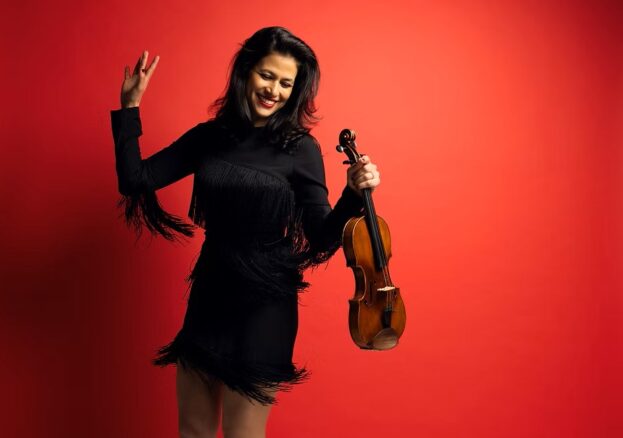
Violinist Elena Urioste and pianist Tom Poster make their Manchester debut as a duo, and the audience gets a say in what they perform.
Elena Urioste isn’t your regular concert violinist. As well as racking up an impressive CV in the classical world – concertos with the Philadelphia and Cleveland Orchestras, the BBC Proms, a professorship at the Royal Academy of Music – she’s also a certified yoga teacher, a writer, an actress, and the founder of a chamber festival. And Tom Poster, for his part, isn’t your regular concert pianist. He composes and arranges for the likes of Yo-Yo Ma, has played on film soundtracks including The Theory of Everything, and once wrote a chamber opera for puppets.
The audience vote has been the duo’s calling card since lockdown. Newly married, with their honeymoon cancelled, the pair began posting a video a day from home as #UriPosteJukeBox, playing whatever their followers asked for. Requests ran the gamut from Mozart and Messiaen to Britney Spears and ‘The Wheels on the Bus’, often performed in fancy dress.
The project soon started generating new music, including Jessie Montgomery’s slow, yearning Peace, written specifically for the Jukebox a month into the first lockdown, and reprised as part of this concert. The composer’s note describes learning to see sadness not as a negative emotion but as “a necessary dynamic to the human experience”.
Also in the programme is Dora Pejačević’s ‘Spring’ Sonata, which brings in the duo’s other calling card: composers who’ve been unfairly overlooked. Pejačević was the first Croatian composer to write a piano concerto, yet much of her work went unpublished for decades. The sonata wears its nickname on its sleeve: unguarded and lyrical, with long singing lines over swirling piano.
The more familiar ground comes with Dvořák’s Violin Sonata in F major, one of his gentlest works, written in a fortnight in 1880. It tips its hat to Brahms in the first movement, then turns distinctly Slavonic in the finale. Rounding out the fixed works is a selection of Fritz Kreisler’s miniatures – short, sweet, Viennese-flavoured pieces that come with a bit of a twist: for three decades Kreisler passed off several of these miniatures as rediscovered works by long-dead composers such as Pugnani and Couperin, before finally admitting he’d written them himself. The irony is that critics used to scold him for programming his own trifles alongside these supposed masterpieces.
After that, the audience takes over, voting on what comes next, choosing from a list that spans classical favourites to Poster’s own arrangements from the Great American Songbook. At a gig, it’s par for the course when a band switches up the setlist or takes a request. In a classical hall, where programmes are usually fixed several months in advance, it’s a rarer – and much more intriguing – format. Then again, a violinist who teaches yoga and a pianist with a puppet opera to his name were never likely to do things completely by the book.