




















The Hallé Presents: Jonny Greenwood at The Bridgewater Hall
Johnny James, Managing EditorBook now
The Hallé Presents: Jonny Greenwood
Always double check opening hours with the venue before making a special visit.

What can an orchestra bring to the stage that nothing else can? For Jonny Greenwood, the answer isn’t power or grandeur, but uncertainty: dozens of players – and the conductor – making countless decisions in real time. It’s here, in the accumulation of those small choices, that what he calls “peril” enters the music. Complexity multiplies across the ensemble as individual character shapes the overall sound. That idea sits at the centre of this Hallé Presents concert, and at the centre of Greenwood’s brand new Violin Concerto.
Jonny Greenwood’s taste for risk is part of what draws him back to the Hallé as a Featured Artist. Best known outside the concert hall as a member of Radiohead, he has long pursued a parallel life as a composer, drawn increasingly towards the colour and physicality of orchestral sound. That includes a long run of film scores – most recently One Battle After Another, which earned him an Academy Award nomination. Those scores sit alongside a growing body of concert work, and an ongoing relationship with an orchestra defined as much by openness as by tradition. “They have such a storied history”, he says of the Hallé, “and yet refuse to be hidebound”. It’s a relationship built through successive concerts, with this programme centring Greenwood’s music and featuring him as a performer elsewhere.
Greenwood’s Violin Concerto began life as the eerie Horror Vacui (literally, “the fear of empty space”), premiered in 2019 by Daniel Pioro at the BBC Proms, before being rewritten almost entirely for this Hallé premiere. The piece draws on electronic soundworlds, particularly those explored by the Japanese composer Isao Tomita, who used electronics to mimic the concert orchestra in the 1970s. But Greenwood’s method for dealing with electronics owes more to Poland’s Krzysztof Penderecki, and his conviction that such textures could be realised more vividly through strings. Following this logic, Greenwood’s Violin Concerto refracts electronic sounds through the orchestra – where more can go wrong.
Greenwood again works with violinist Daniel Pioro on the concerto’s solo part. Described by The Telegraph as “the violinist making classical music cool”, Pioro’s playing becomes a focal point around which the orchestra is treated as a resonator, exploring how digital and analogue sound processing can be reimagined through instruments as old as violins, violas, cellos and basses. The results, Greenwood says, are more complex and interesting than the electronic originals that inspired them. They’re also different every time the orchestra plays the piece, and this variability lies at the heart of what draws him to this way of working: “Its impermanence feels utterly contemporary to me”.
Alongside the concerto, Water offers a different perspective on Greenwood’s writing for strings. Taking its cue from Philip Larkin’s image of light endlessly refracting through a glass of water, it places the Hallé’s string section at the centre of a slowly unfolding soundworld, enveloping two flutes and an Indian tanpura – played by Greenwood himself – in shifting layers of colour. Where the concerto leans into risk and complexity, Water works through warmth and texture, in an extended meditation on sound in a constant state of transformation.
The rest of the programme places Greenwood’s music within a wider lineage of composers preoccupied with what strings can express. Witold Lutosławski’s Musique funèbre, written in memory of Bartók, draws on twelve-tone thinking, treating each pitch with strict equality as its intensity is accumulated and held. Steve Reich’s Pulse, heard previously with the Hallé and Greenwood in 2025, takes a different approach. Written in a conscious act of restraint, long, lyrical lines arch over spacious harmonies anchored by an electric-bass pulse, played here by Greenwood. The music moves without urgency, resisting Reich’s more familiar drive towards climax, in favour of quiet reverie.
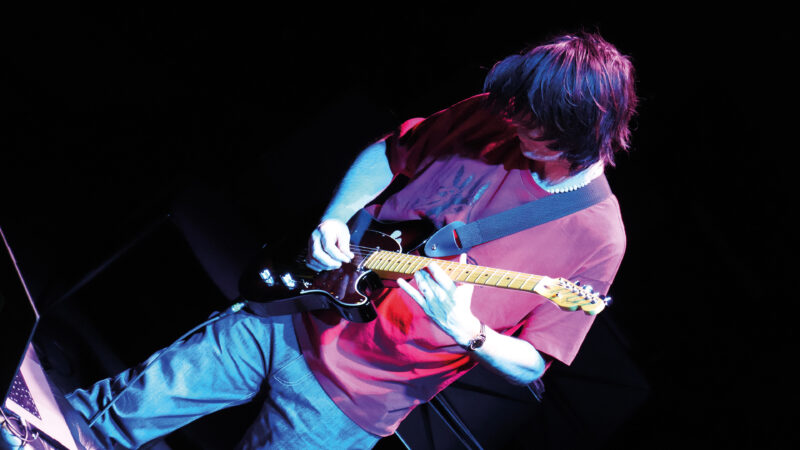
With Greenwood’s Violin Concerto at its centre, the programme returns to what string writing, and the orchestra more widely, can make possible. For Greenwood, it continues a special relationship with the Hallé, shaped over multiple collaborations in Manchester. “It’s exciting – and daunting – to be working again with the mighty Hallé,” he says – a tension that’s written into the fabric of his latest music.