







A street history of the nude. Daniel Miller on Spencer Tunick.

As the latest UK exhibition of Spencer Tunick finds its feet at The Lowry, Daniel Miller tries to discover why Spencer, like so many artists before him, chooses to work with the nude. Plus, below, a behind-the-scenes vodcast of what it was actually like to bare all in Salford this spring.

Jacques Derrida recounts an experience of waking up one morning, and crossing from his bedroom to the shower. Midway through his journey the philosopher is struck to discover ‘oneself naked, one’s sex exposed, stark naked before a cat that looks at you without moving, just to see…’ He feels ashamed, and this makes him feel more ashamed. He wonders if nudity is the difference between humans and animals, felines and ‘the animal, that, therefore, I am.’

Besides humans, no animal has ever attempted to dress itself. But the attempt at some point always fails. This cat arrives ‘like an ambassador… [charged with] the immense symbolic responsibility with which our culture has always charged the feline race’ to remind the philosopher of a dumber reality. Language is clothing; a way of dressing appearances. Silence, nakedness and truth (‘the naked truth’), beyond rhetoric, exist together in an intimate embrace. Perhaps this is why the nude has been a subject of art for so long.

Nakedness manifests both our human and animal natures. The nude aestheticizes the experience, and intensifies the contradiction. Kenneth Clark cites Aristotle: ‘Art completes what nature cannot… finish.’ Nature cannot finish human nature. Our Sisyphean species is drawn to keep redefining itself. The nude cloaks the condition in an idealized form. From Michelangelo to Manet, what’s represented in the nude is never nakedness exactly, but the naked body as a medium, or a message, or an index. At the height of the Renaissance, the idea was transcendent vitality. On the ceiling of the Sistine Chapel, or outside the Palazzo della Signoria, the nude was epic and virile, larger than life. After the Industrial Revolution, and mankind’s  industrially refined status, the nude became increasingly perverted, sickly-sweet.

These portrayals expressed their contemporary realities, in each case as a mirror of the artist’s power. Whereas in the Renaissance the artist was a man of strength, overflowing with life, by the fin-de-siecle he had become despised; an error in creation who aestheticized his own abjection. Industrial civilization introduced a new agent: photography, the bearer of a more machine-like vision. Photography created the circuits for the distribution of new nudes – in cinema, advertising, pornography and photojournalism. These new channels relaxed social attitudes governing the exposure of flesh, while at the same draping flesh in multiplying layers of media.

Today, a hyper-rapid information system extends across the planet. There has never been more access to data, and never less ‘naked’ data. Everything arrives third-hand, premeditated, veiled; touched by millions of unseen users, servers, robots, clients, packaged, routed, sorted, processed, linked…

Spencer Tunick’s productions belong to this paradigm. All that’s offered is a proposition: an opportunity to experience mass public nudity. This is accompanied by an alibi – ‘you can call it art’ – and a proviso – ‘you will become (part of) a media spectacle’. The first clause preserves modesty; the second one powers the enterprise, supporting the caravan as it moves around the planet. Only a tight-ass could straightforwardly criticize this. You could argue that it is populist and superficial, or claim that public nudity is ugly and immodest, in whatever form it takes, but in both cases what you’d have would be a cover-up, masquerading as an exposé.

The key facts are that it is harmless, and there is a desire to do it. Both points chime perfectly with the naturist ideology, and specifically the agenda of the naturist Freikörperkultur. In the last several decades the FKK has succeeded in relaxing restrictions on public nudity in Germany and elsewhere. What does this trend mean? The British media generally likes to report the story from the freakazoid army-of-nudists angle, but the mainstream attitude in Germany, besides the lakes and in the mixed-sex saunas, is closer to benign indifference. This also pretty much sums-up my views of Spencer Tunick, which I take to be a testament to his success.

Tunick resembles a kind of FKK propagandist, bringing naturism new converts through spectacular means. For some of the reasons briefly given above, this MO hasn’t won him too many friends in the art press. There are other reasons for that; as Boris Groys observes at one point in Art Power, a contemporary art critic is something close to a valet, dressing ‘naked’ artworks in a textual bikini. ”Images without text are embarrassing,” Groys states, ”like a naked person in a public space.’ No man is a hero to his valet; Spencer Tunick embodies a core threat to our being.

Formally, this is by-the-book modernist art politics, that is, an aesthetic program of mass mobilization. Content-wise, it links arms with contemporary activist strategies, in which people strip off to raise money and/or promote causes (‘I would rather go naked than wear fur’ is probably the best example). Tunick has used this strategy himself, for example, by working with Greenpeace on ecological activism. But the general cause is public nudity itself. This is non-ideological, but still subversive. Celebrating a humanism of the naked body runs counter to two thousand guilty years of Western history. It also runs counter to dominant media narratives, with their heavy commercial investment in airbrushed and sexualized bodies. The media is invested in Tunick’s narrative too, of course, covering his installations (giving them exposure) from Australia to Wien. But then as Freud once (almost) pointed out: the media knows no contradiction.

A freer relation to nudity is probably the wave of the future. But the other side of the issue isn’t concerned with morality, but technology. The technological will to bend bodies into functional shapes, and recreate humans as characters patterned after its own image survives into the present. Today, workers on laptops across the digital world corporeally submit before the needs of a machine; ironically, given that the eternal promise of technology is emancipation from the human body’s limits. More sophisticated than its fathers, the contemporary version of this promise is an embodied emancipation from technology itself; by means of a hyper-technology which has transcended the natural body’s natural limits, which has transcended itself, and in the last instance, has transcended death. It’s a lie. What did Derrida realize as he was crossing his living room, and what do Spencer Tunick’s participants on some level realize as well? That the living body is a dying body, and there’s nothing we can do.

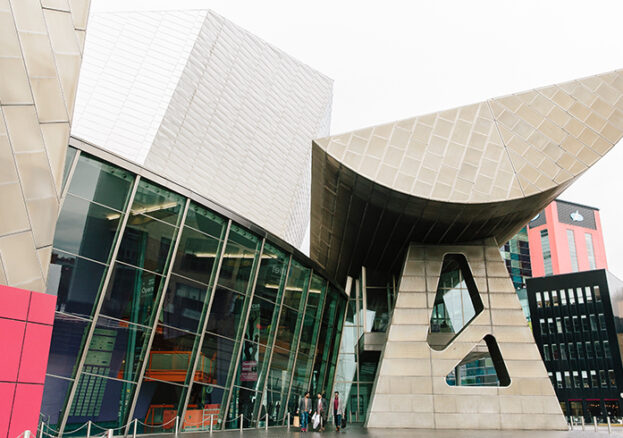
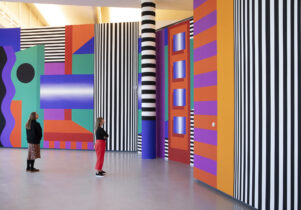
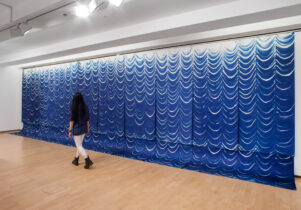
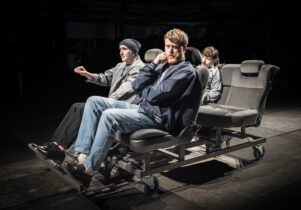
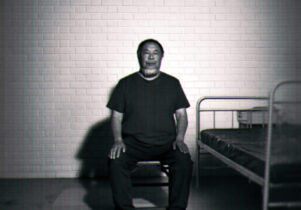
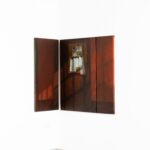
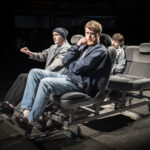
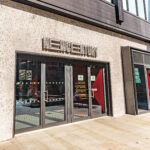
Everyday People: Spencer Tunick at The Lowry, until 26 September. Free. Daniel Miller is a writer based in Berlin. Images (to to bottom): Everyday People: Spencer Tunick at The Lowry, courtesy Spencer Tunick; Dublin, Ireland, 2008, courtesy Spencer Tunick; installation shot, courtesy Heidy Elainne; Everyday People: Spencer Tunick at The Lowry, courtesy Spencer Tunick.

Possibly related to this:

  1. The final countdown. Last chance to see Spencer Tunick. This is it: your last chance to see Tunick's exhibition at The Lowry - it closes this Sunday (26 Sept)....
  2. Fancy yourself an art critic? The Lowry is after a reviewer. To mark the mid-point of its photography show by Spencer Tunick, The Lowry has teamed up with Creative Tourist to...
  3. More than one way out: Leo Fitzmaurice at The Lowry We speak to the artist as he installs his latest exhibition...
  4. Good nudes day. Former Tate curator Simon Wilson strips off for art's sake - and lays bare the Spencer Tunick experience...
  5. Spencer Tunick at The Lowry. A naked tale of two cities. Susie Stubbs heads to a press launch at The Lowry ahead of its latest commission and finds people ready to...

Filed Under: Features

Tags:

RSSComments (5)

Leave a Reply | Trackback URL

  1. Rise Art says:

    I would like to know if there is anyone who participated in one of these actions reading this blog? I would like to know what the motivation is, to participate in such a project? Is is really because it is ‘art’? or is there another motivation behind it? Speak up!

  2. susie says:

    Hello there. Not entirely sure what you mean – are you after people who took part in the Spencer Tunick installation? Have a look at http://www.thelowry.com/spencertunick if so, they have some blog posts and clips from people who did indeed strip in the name of art. Or search under ‘Simon Wilson’ on this site and read his account of what it was like to get naked for Spencer.

  3. Howard says:

    I took part in the Sunday installation in Salford. The motivation for myself was based on a number of things. For one, I’d been aware of Spencer’s work since seeing a feature on his installation at the Cutty Sark. Also, as a photographer myself, there was the opportunity to see how he works with what seemes like such an impractically large group of people.
    Everyday life – for me at least – is incredibly routine and mundane. The installation was an opportunity to take part in something unique.
    Lastly was the inevitable “personal liberation” effect. When there’s several hundred of you all stood there naked, being naked becomes the norm very quickly, and without anything labelling us – be it our wealth, style or lack of – it puts everyone on an even level. Without anything to trigger social stigmas, groupings and seperations, I found it very easy to speak to others without any shyness, and noticed others doing the same.

  4. Peter Jacobs says:

    I would echo much of what Howard has said. I took part on the Saturday and I was already aware of and interested in Spencer Tunick’s work and had thought for a couple of years that I would be interested in doing one. For me, the opportunity fulfilled two ambitions: firstly, to be in a piece of art; and secondly, to take part in some kind of mass nude participation event. I expected it to be personal challenging and experienced some real fear as we left The Lowry to board the buses for the first installation.

    There is for most people it would seem a benefit to be found in the experience in that it is a personally liberating experience. The feeling of being stripped of all one’s social markers – clothing, jewellery and such, in a positive and creative spirit, in a large group of people of all ages and physical types, is strangely compelling and I soon felt a mixture of ease and astonishemnt at how wonderful it felt. It was genuinely liberating, and I felt sometimes a great awareness of my physical self, my environment and my ‘normalness’ among this extraordinary group.

    I have since taken part in a second Spencer Tunick installation. It’s oddly addictive.

  5. Hi, im from france so my english isnt that superb. Please dont blame me. I try to read online journals to make my english better and i just want to say that your blog was perfect readable for me, because the english is really clear-thinking and all the article are perfect readable. I will come back, to improve my english even more. Thanks a lot :)

Leave a Reply