












Yuki Kihara: Darwin in Paradise Camp at The Whitworth
Johnny James, Managing EditorVisit now
Yuki Kihara: Darwin in Paradise Camp
Always double check opening hours with the venue before making a special visit.
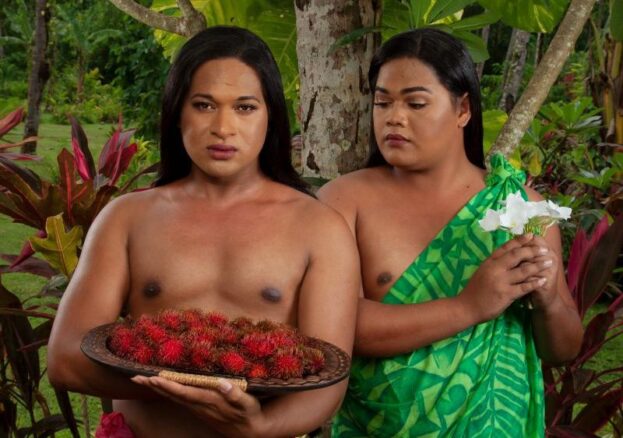
For more than 20 years, Japanese-Sāmoan artist Yuki Kihara has mined art history and colonial archives to show how empire shaped both the Pacific and the ways it was imagined. Much of her work foregrounds the perspectives of Sāmoa’s Fa’afafine and Fa’atama – longstanding third-gender communities she belongs to, yet which colonial narratives routinely distorted or erased.
Paradise Camp, first shown at the Aotearoa New Zealand Pavilion at the 59th Venice Biennale in 2022, pushes that project into sharp relief. Kihara takes Paul Gauguin’s Tahitian paintings – images long propped up as “authentic” visions of the Pacific – and “upcycles” them into twelve lush photographic tableaux shot on Upolu Island. Fa’afafine performers step into compositions once defined by a European lens, while little-seen colonial photographs from Sāmoa surface to expose the visual myth-making behind those earlier images.
Drawing on a practice that has taken her to major venues from The Met and MoMA to the Venice Biennale, Kihara worked with Fa’afafine models and crew to repurpose material from what she calls the “landfill” of stereotypical Pacific imagery, turning it into portraits that speak from, and for, queer Indigenous worlds. The result is both homage and critique: beauty sharpened into a form of reclamation.
Because Paradise Camp evolves with each presentation, its Whitworth iteration introduces a major new component: Darwin Drag. This video installation engages with contemporary research suggesting that Charles Darwin shaped parts of his evolutionary writing to fit Victorian moral codes – downplaying the breadth of same-sex behaviour found across species. Kihara responds with theatrical clarity. She appears prosthetically transformed into Darwin himself, confiding in celebrated Sāmoan drag queen BUCKWEAT about the “queer species” he kept hidden in his notebooks: clownfish, parrotfish and other marine life found across the Sāmoan archipelago, whose sex-changing and social behaviours trouble tidy heteronormative categories.
The film blends scholarship, satire and ecological insight, and is shown inside a replica fale – the open, pavilion-like Sāmoan house – alongside fish specimens that extend its scientific and cultural unriddling. Taken together, Paradise Camp and Darwin Drag form a vivid counter-history: a re-reading of both modernism and evolutionary theory through the eyes of those they once wrote out of view.