





















Waiting for Godot at Bolton Octagon
Johnny James, Managing EditorBook now
Waiting for Godot
Always double check opening hours with the venue before making a special visit.
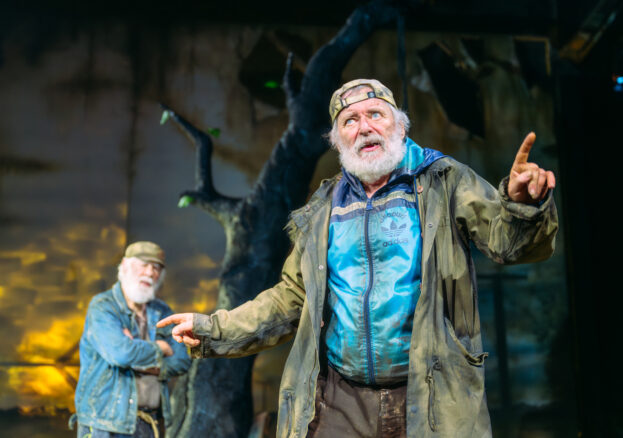
Two men wait by a tree for the arrival of someone who may never arrive. Somehow it captures something essential about being human. Naturally, there are more questions than answers. Who – or what – are they waiting for? Rescue, purpose, tomorrow? Whatever it is, what if it never actually comes? Well, at least they’re together…
Unlikely raw material for a modern classic, yes, but Waiting for Godot remains one of the most influential theatre works of the 20th century. More than 70 years after its premiere, Samuel Beckett’s breakthrough play still feels strange, oddly moving and darkly funny – and it looks set to land with all its tragicomic potential in the round at Bolton Octagon.
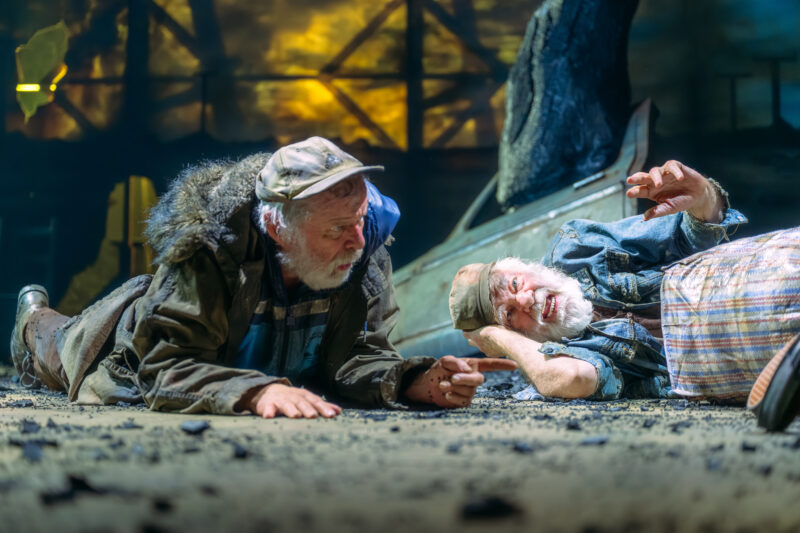
Directed by Dominic Hill, this staging brings together Matthew Kelly and George Costigan as Beckett’s hapless duo Estragon and Vladimir – two men who find themselves stuck in time and trying to fill it. They bicker, clown, reminisce and irritate each other, passing the hours as they wait for the arrival of the mysterious Godot – someone who may, of course, never come.
Waiting for Godot is less interested in telling a story than in observing how people behave when nothing much happens. Beckett strips away the usual comforts of plot and resolution and leaves behind something barer and uncomfortably recognisable: the rituals, jokes and little performances people invent to fill the hours. In that strange, suspended world, companionship is crucial, though never sentimentalised. Estragon and Vladimir are flimsy, irritable, ridiculous company for one another, but they are company all the same, and that counts for a lot in Beckett’s world.
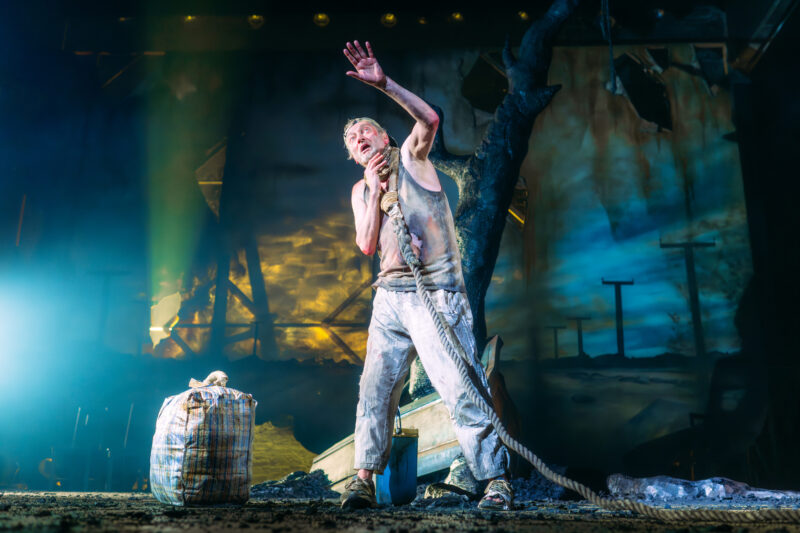
Hill’s production places those small human rituals inside a stark and unforgiving world. Reviews from its Glasgow run describe Jean Chan’s design as a blasted, threadbare landscape – less roadside than end-of-the-road. A charred tree stands over the remains of a truck, while the wider world appears ripped open and worn through. It sounds post-apocalyptic without tipping into cliché, and that feels about right for a play in which – despite meaning having been lost – life goes on.
Just as importantly, this is not Godot presented as a forbidding intellectual puzzle. Beckett’s play has deep roots in music hall, vaudeville and double-act comedy, and that comic engine is very much alive here. Kelly and Costigan have been praised as a bleakly funny pairing, held together by fraught interdependence and shared weariness. The laughs are not a distraction from the bigger ideas. They are part of how the play works. Beckett knew that comedy and suffering are rarely far apart; often they are sitting on the same bench, passing the time.
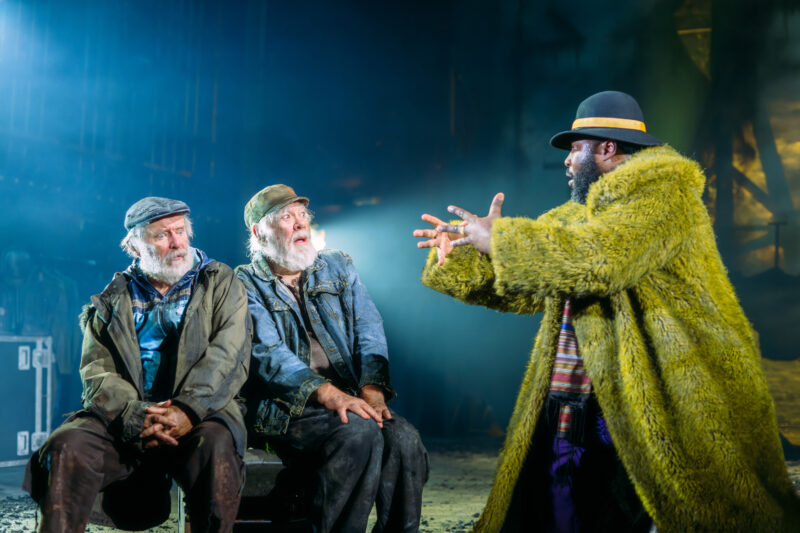
The arrival of Pozzo and Lucky disrupts the fragile equilibrium of Estragon and Vladimir’s world. Their own relationship offers a harsher vision of dependence – one built on domination, cruelty and spectacle. Their arrival jolts Vladimir and Estragon’s repetitive waiting into something more volatile and, if possible, stranger.
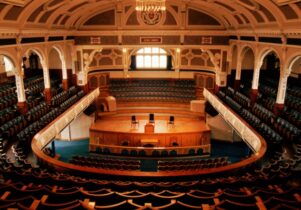
In-the-round at Bolton Octagon, there’ll be no easy distance from Beckett’s quietly devastating world.