






















Einstein on the Beach at Aviva Studios
Johnny James, Managing EditorBook now
Einstein on the Beach
Always double check opening hours with the venue before making a special visit.
One of the most influential stage works of the last 50 years is also one of the least performed. Einstein on the Beach takes a hell of a lot to stage, and this new production from Factory International and English National Opera makes it a bigger task than ever.
In 1973, Philip Glass was still an obscure avant-gardist on the downtown New York scene, with a penchant for repetition. That year, he sat through all 12 hours of The Life and Times of Joseph Stalin, a silent theatre show by the director Robert Wilson. Afterwards, Glass went backstage to tell Wilson he’d liked it, and the pair bonded over a shared mathematical approach to making work.
Within months they were planning a piece together. Its subject was Einstein, whose ideas about space and time had, some 70 years earlier, upended how the universe was understood. But this is no biopic. There’s not even a narrative. It’s built from images drawn from the physicist’s life and ideas – clocks, trains, a spaceship – juxtaposed with sequences of abstract dance. When it premiered in 1976, nearly five hours long, with no interval and the audience free to come and go, it broke so many rules that, as the Los Angeles Times critic Mark Swed later put it, “opera in America can be divided, plain and simple, before Einstein and after Einstein.”
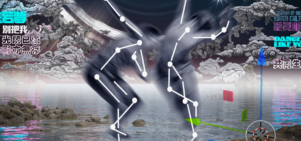
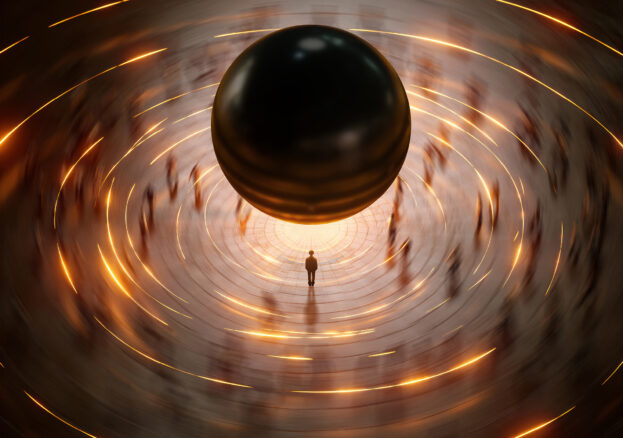
50 years on, Phelim McDermott has completely reimagined the piece, working closely with Glass in the composer’s 90th year. About the only ‘normal’ thing about the original was that it played out on a stage in front of its audience. McDermott’s staging, designed by Tom Pye of My Neighbour Totoro fame, puts the audience at the centre of the action. They’re surrounded by a collision of artforms – music and theatre, live art and light, sculpture and movement – where Einstein’s ideas and Glass’s music are experienced in 360 degrees. It’s the kind of thing English National Opera “simply can’t do in other cities, such as London”, Factory International’s Artistic Director John McGrath noted with some relish at the launch of the 2027 programme.
The music is built from tiny figures that grow and shrink a note or two at a time. These notes fly past in rapid, repeating patterns, but the harmony beneath them barely shifts, making it feel fast and slow at once – fitting for a piece about the man who showed that time isn’t fixed. Meanwhile the chorus mostly sings numbers and the names of notes rather than words. Written for Glass’s own amplified ensemble of organs and winds, this is the score that turned an obscure avant-gardist into minimalism’s standard-bearer. It’s played here by the BBC Philharmonic under Brad Lubman, alongside the Chorus of ENO and Kantos Chamber Choir.
Opera, as an art form, can come loaded with assumptions, but this one, McGrath told Creative Tourist, “doesn’t actually fit anybody’s clichés of what an opera is. It’s more like an immersive kind of, dare I say, a chill-out experience.” Audiences can wander in and out, or even “have a bit of a doze in the middle of it, and that’s fine”. Glass and Wilson, he notes, were always curious about how the piece might interact with people’s dreams.
Described by McGrath as “arguably our vastest show of the year”, Einstein on the Beach doesn’t come around very often, and never like this.