
















Return to the Forest at Aviva Studios
Johnny James, Managing Editor
Book now
Return to the Forest
Always double check opening hours with the venue before making a special visit.
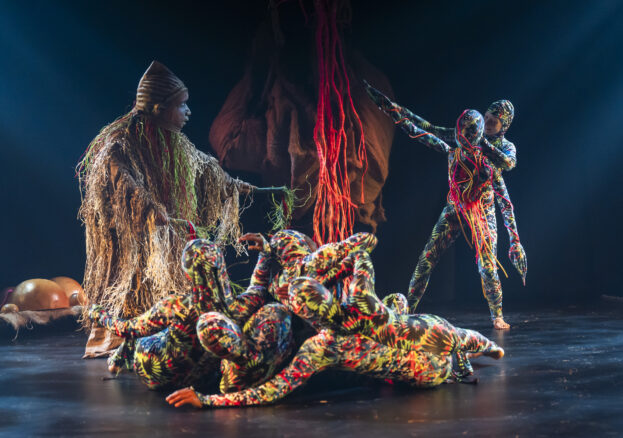
Children’s theatre is often underestimated. There’s an assumption that, because it’s for kids, it must be simpler, softer, smaller. Theatre-Rites have spent more than 20 years challenging that idea, making work that insists young audiences deserve the same artistic ambition as anyone else. Return to the Forest is a brilliant example: a high-concept puppetry and dance show that smuggles big ideas into play, and gives children licence to push the boundaries of what a theatre experience can be.
Below, we speak to director Sue Buckmaster and choreographer Gregory Maqoma about the ideas behind the work – Jump to the Q&A
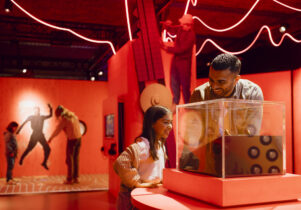
Return to the Forest invites children aged 8+ to step inside a museum space filled with precious objects. When dusk falls, the objects begin to stir, as if they’re yearning to be freed. As the objects drift through the building, the audience follows, transported from the museum into the heart of a wild and magical forest – via spaces within the venue that are usually off-limits. This journey balances mischievous magic with a more serious undercurrent, exploring our relationship to objects, environments and the stories we tell about where things belong.
That balance is shaped through collaboration. Return to the Forest brings together Theatre-Rites and award-winning South African choreographer Gregory Maqoma, whose high-energy movement guides the journey, alongside the magical puppetry of Theatre-Rites director Sue Buckmaster. It builds on The Global Playground, their previous collaboration for Manchester International Festival 2021, which The Reviews Hub called “a playful, uplifting, deceptively simple dance confection… with an appealing, infectious energy and a clear message about the power of play.”
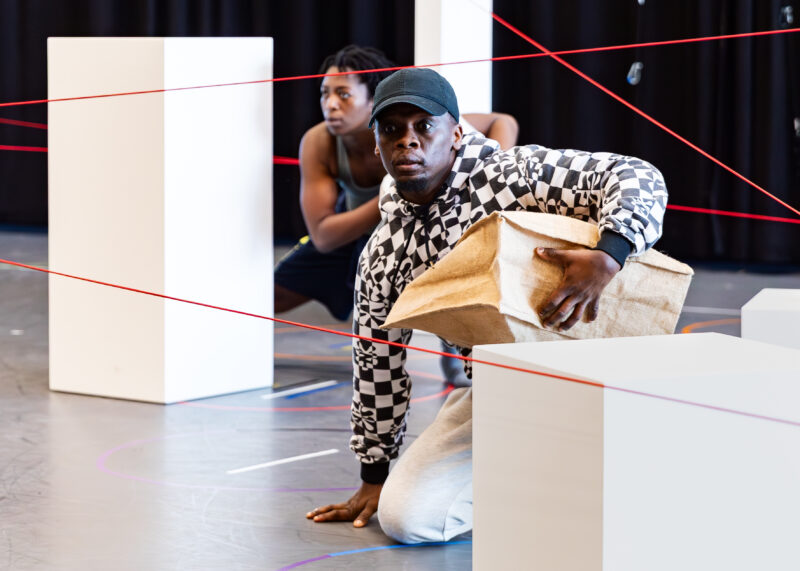
Rather than fixing its audience in place, Return to the Forest unfolds through movement and participation. With a limited audience size, children are guided through the building as the work develops around them, becoming part of the action. That feeling of being gently out of bounds – of wandering into spaces they might not usually be allowed into – is central to the show’s mischievous energy, carefully constructed to give young audiences a sense of agency.
What begins as playful transgression gradually opens onto more complex ideas. Without spelling them out, the work invites reflection on care and ownership, on museums as places with an ethical function, and on wider questions of ecology and colonialism. These ideas aren’t presented as lessons to be learned, but as experiences to be felt, leaving space for young audiences to make sense of them in their own way.
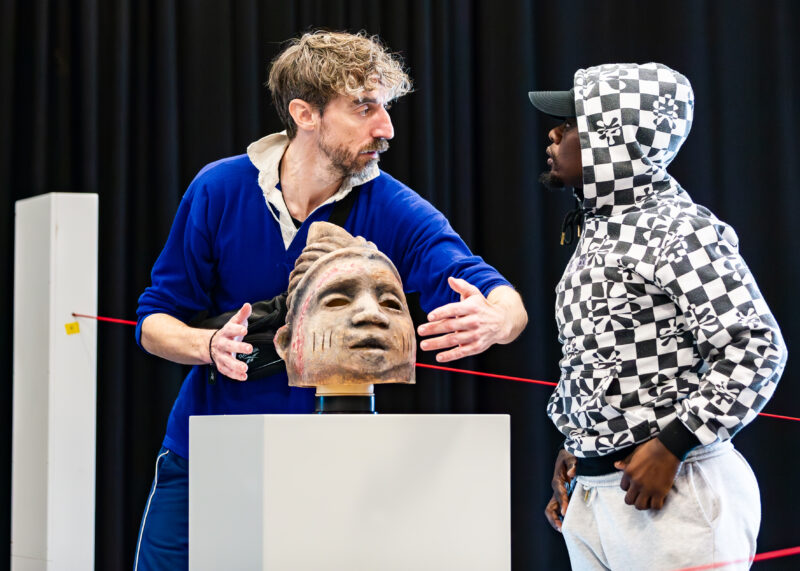
As with all of Theatre-Rites’ work, accessibility is built into the form. Return to the Forest is non-verbal and sensory-led, allowing audiences to engage on multiple levels. The work is also shaped through ongoing collaboration with children during its development, with small groups given behind-the-scenes access and a sense of authorship as the piece evolves across different venues. That process feeds directly into the live experience, resulting in a show that feels porous and responsive to the people encountering it.
Premiering at Aviva Studios before travelling to Sadler’s Wells East, Return to the Forest makes the case for children’s theatre as something ambitious – capable of holding complexity, asking difficult questions, and trusting young audiences to engage with them.
To dig a little deeper into how the piece was made, we spoke to director Sue Buckmaster and choreographer Gregory Maqoma about ambition, objects and the thinking behind the work.
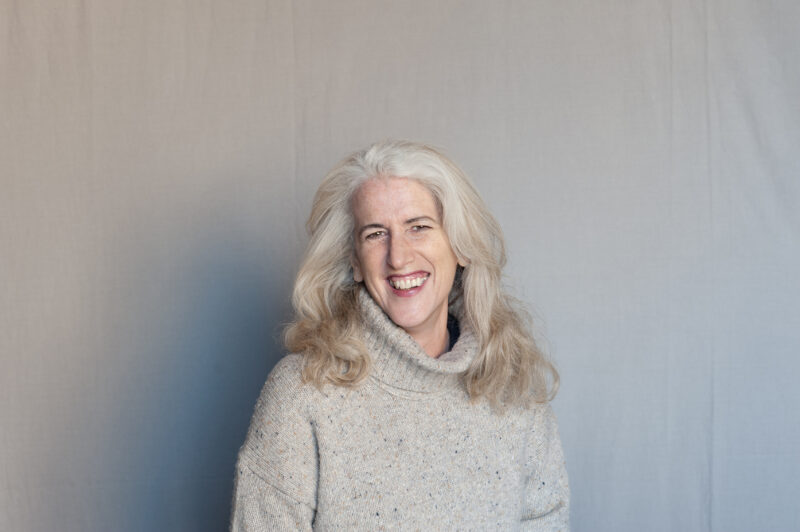
Q&A with Sue Buckmaster and Gregory Maqoma
There can be a perception that work made for children isn’t as ambitious as work made for adults. How does Return to the Forest push against that – and why does that matter to you?
Sue – As an artist who has been constantly evolving my practice, I find it essential to be ambitious and challenge myself. I also have the pleasure of collaborating with incredible artists who are equally ambitious and want to seek new ways of seeing and exploring the world.
I believe children, as much as adults, deserve to be exposed to a wide range of artistic inspiration. I am disappointed when the assumption is made that they will only enjoy adaptations of existing TV programmes or books. Of course they might, but they might also like to see what artists are discovering in the ‘now’.
Theatre-Rites was established 30 years ago to ensure that younger audiences can experience art which can be assessed alongside the latest trends in creative thinking. Children, of all the members of our society, are the worthiest of seeing how new visions can thrive and help inspire a sustainable future.
The show begins in a museum-like space before the setting transforms. What drew you to museums as a place to start?
Sue – All of Theatre-Rites productions are ‘object-led’. That means the process doesn’t start with a script or an issue – it begins with an object and sees what narrative or subject that can tell us about.
When Gregory Maqoma and I decided to research a new production, I asked him to bring an object with him as a starting point. He brought an Ishoba, a healing stick from South Africa, made by his brother who is a Healer. It was by playing with this object and listening to its ancestral wisdom and physical origin that certain creative ideas began to emerge. I also asked Visual Artist Bunmi Agusto to introduce an object to Gregory and I and she helped us reimagine a contemporary mask inspired by her Yorubic culture in Nigeria; a Gelede Mask. This inspired further ideas for dance and puppetry.
It was at that point when Bunmi said to me ‘of course the traditional masks are just dead objects when hung in a museum’ removed from their original purpose. So, in the research weeks we asked the objects where they would rather be, or where they once thrived. Both the Ishoba and the Gelede took us back to the Forest. To nature.
Thus, the rough structure of the performance, starting in a museum, was born and we named it ‘Return to the Forest’.
The piece unfolds through movement and participation rather than fixed seating. What does that format allow you to do that wouldn’t be possible if the audience stayed in one place?
Gregory – This format allows the audience to become part of the movement and changing spaces rather than witnesses to it. When we remove fixed seating, we also remove the hierarchy of who performs and who observes. The space becomes porous, alive. The audience is invited to navigate, to choose where to look, what to follow, what to feel. For me, that is closer to how memory actually works – fragmented, embodied, constantly shifting. You don’t sit and watch memory, you move through it. This format allows us to activate that sense of discovery and intimacy.
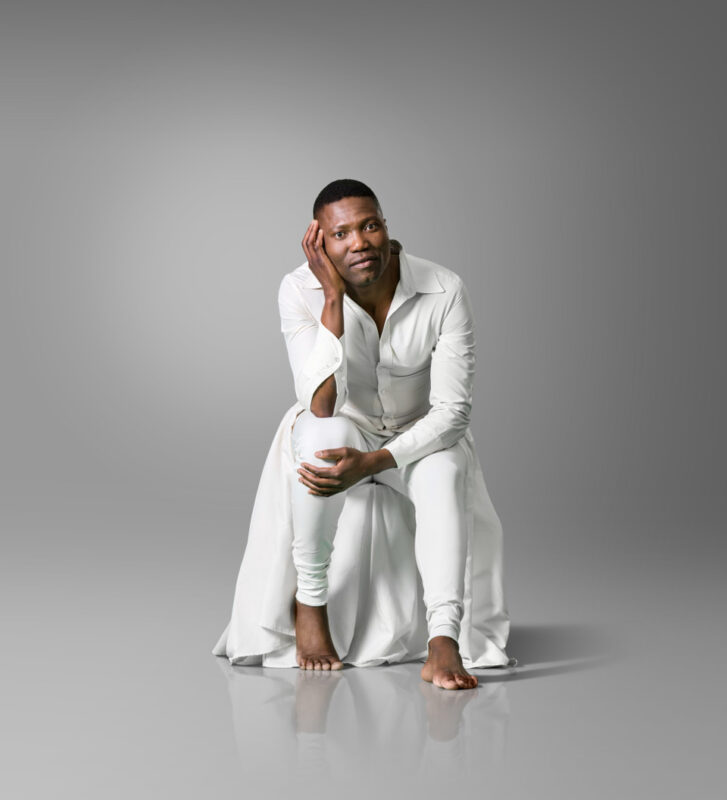
At times, the audience finds themselves in spaces that are usually off-limits. What are you hoping to give children through that feeling of ‘breaking the rules’?
Sue – This is an interesting phrase ‘off limits’. It is politically charged. It depends on who it setting the limit – culture, gender, age, those in power, a parent? Maybe I would describe this piece as allowing the audience of adults and children a chance to go beyond the limits of the real museum and enter an imaginary, less literal world. A world where magical things can happen. Perhaps the idea of a heist at a museum appears at first glance to be criminal, but in this performance the objects are asking to be released. So, we can have the fun of appearing to break the rules whilst it is actually, also about respecting and imagining what possibilities can truly lay dormant in things and the people who are restrained.
Children, when breaking the rules are usually just healthily stretching the boundaries of what feels right. Depending on your up-bringing, as adults and children we are constantly questioning the barriers often imposed on us from a cultural perspective or educational directives. Children are often the bravest when allowing the imagination to look beyond the obvious or familiar.
Children are our best divergent thinkers and can question what adults think is a useful ‘rule’. That’s why it so gorgeous when adults and children see the work together. We can all break free from our restraints, real or imaginary.
There’s play and mischief running through the work, but also deeper questions around colonialism, ownership and the stories attached to objects. How do you balance those different layers of the experience?
Gregory – Play is a very powerful entry point. It disarms. It opens the body and the imagination before the intellect begins to interrogate. For young audiences especially, play creates permission to engage, to question, to participate without fear of being wrong.
But beneath that playfulness is a very deliberate inquiry. Objects carry histories, often violent ones and many of those histories have been sanitised or erased. By introducing mischief, we create moments where the familiar becomes strange again. A simple object can suddenly feel loaded, contested, alive with story.
The balance comes from trust: trusting that audiences, even young ones, can hold complexity. You don’t need to explain everything. You create an experience where joy and discomfort can coexist, where laughter can sit alongside questioning. That tension is where meaning begins to emerge.
How would you describe the puppetry for this project, and what does puppetry make possible here that a purely human performance wouldn’t?
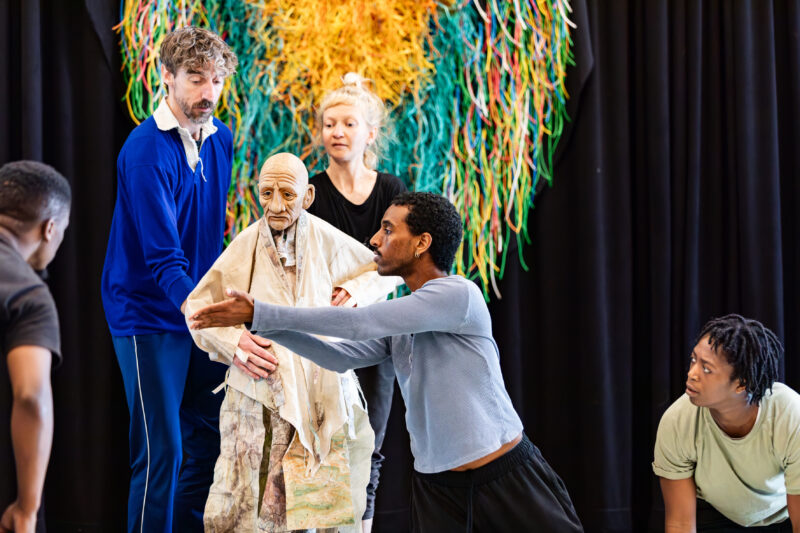
Sue: The puppetry for this project is inspired by Masquerade practice from around the world, whether that be the various mask figures that use an Ishoba stick in different countries, the elaborate masks of West African traditions, the Mas celebrations of the Caribbean, to the many versions of Krampus around Europe and the folk dances and hobby horses of the UK. The essential element of Masquerade is its ability to make the wearer invisible. Many would say it is so that the wearer can disappear and take on a spirit of something bigger than themselves and perform with that creative energy for the benefit of the well-being of the community it is celebrated within.
In this show a number of artists, from all over the world, have shared the objects and masquerade practice which they have encountered. As a team, we have allowed these references to give birth to some new contemporary masquerade figures who will hopefully have their own exciting and maybe healing impact on our audiences.
How did you approach the choreography, and what kind of movement language felt right for guiding young audiences through the experience?
Gregory – I leaned into rhythm and gesture as anchor and allowing the puppets, objects to lead the idea. From there, the work expands into layers: shifts in tempo, direction, proximity. The dancers become guides, not just performers, inviting, redirecting, sometimes disrupting forms.
There is also a strong sense of play in the physicality, moments of exaggeration, surprise, even humour but always rooted in precision. The aim is to create a language that can hold attention, spark imagination, and gently lead audiences into deeper reflection without forcing it.