











Interview with Richard Wilson (transcript)

Participants
SP = Sarah Perks
AG = Adalet Garmiany
RW = Richard Wilson

Recording starts
SP: I’m Sarah Perks, Programme Director at Cornerhouse and co-curator of Contemporary Art Iraq. I’m delighted to introduce my co-curator Adalet R. Garmiany and leading British sculptor and artist, Richard Wilson. Adalet is also an artist and he runs a company called ArtRole. So Adalet, can you tell us first of all a little bit about ArtRole, and then how this exhibition started?

AG: I founded ArtRole in 2004, it’s a UK based organisation. Basically our main mission is to build a bridge between UK, Iraq, the Middle East and the United States as well. Conversations started initially two years ago, first when I dropped an email to you, Sarah. We were both interested with the idea and we met up a number of times and we discussed the possibilities, if it’s surreal or it’s really practical to be able to bring real artwork from a country like Iraq.

SP: I think a crucial stage in the development of the exhibition was when Adalet invited me to Iraq and to the Post-War Art and Culture Festival, which was held in Sulaymaniyah at the Red Jail last November. And as well as meeting lots of Iraqi artists and understanding a lot more about what was happening in Iraq and Iraqi Kurdistan, I met lots of other people there, including leading British sculptor Richard Wilson.

RW: I met Adalet through a dear friend, and Adalet at that time had started to think about ArtRole and how that little germinating moment of ArtRole could expand. And the first notion was to take an arts delegation out, along with local participants from the region actually, from Sulaymaniyah. We put on a performance which engaged us with a little bit of the history of the Red Jail, and also to sort of exorcise in some way part of that unfortunate history, and deliver an announcement that this was now a creative space to be used ultimately as a big festival space, and in the future as an arts space.
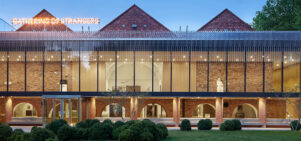
SP: This exhibition is full of artwork from across Iraq. There is a majority or a focus on Sulaymaniyah and Iraqi Kurdistan in the North East. Could you just explain why that is, Adalet?

AG: The reason has had autonomy since 1991, so it’s almost twenty years they have stability. When we see this exhibition and what we saw before throughout our projects with the area, there is a good movement and you can see across the country artists are passionate, and they want to get involved more with outside of Iraq, and they want to know what’s happening with the rest of the world. Because Iraq generally has a very powerful history, especially with the visual art. I mean in 1965 Henry Moore was invited to go to Baghdad taking part in the Baghdad Biennale, so basically there is a history there.
SP: Despite our best efforts to invite some of the artists and also some of academics to talk about contemporary art in Iraq, sadly all their visas were declined, so we haven’t been able to bring them to this opening and to this opening weekend of events.
RW: Well, it’s unfortunate, number one, because I was going to meet up with friends again. It’s obviously becoming much, much stricter. Iraqi artists have been here a couple of years ago, part of the early ArtRole.

AG: The state of the country like Iraq or Afghanistan, it’s not easy to set up any nature of art and culture project without having support from the local government, as well as the British Government itself. So they have been absolutely wonderful in supporting our project logistically, financially as well. And this time what we’re talking about, the issue is not about just these five artists, it’s about what art and the art scene is facing in the United Kingdom.

RW: And the artists aren’t allowed to be here to divulge those secrets about how that work comes about, and some of the stories about why that imagery is on the walls here in Manchester.

AG: Absolutely. I mean in terms of the nature of this exhibition, certainly with Cornerhouse, this is the first time such a massive exhibition has taken place in the UK from Iraq. But as far as I’m concerned, if you look at the nature of the work, and when we talk about the new medium in conceptual art, generally this form of art is very recent in Iraq, and as we said, especially in Kurdistan Iraq. So if you like at the prospect, it’s the first time in the history of both countries to set up such an exhibition and has given a great opportunity for the Iraqi artists, their work, their voice, their visions reach the UK and reach the rest of the world, as well to give the great opportunity to the British public, British art generally to know to come forward to see Iraq is not what we see normally on the telly, exclusion and killing and instability. There is a life there and people can come to see through the films and through this method how they interpret their life. And what’s great about the nature of this project also, we are connected to the local.

SP: Absolutely, and artists are really well placed to do that, to be able to communicate their ideas and thoughts, and I really hope that people coming to this exhibition will be really impressed by the diversity, not just of the various mediums that have been used by the artists, but the issues that they tackle, the concepts. I think it will really address people’s, whether they realise it or not, a sort of stereotypical attitude that they had towards Iraq; obviously not helped by media coverage being exclusively about conflict.

AG: Each artist especially, they’ve been selected from different parts of Iraq, with a different age, a different experience, a different art form – each one will tell a different story. And I think this is a great opportunity to see first what their level of art looks like, to see the form of art they use, as well as their theme and the vision behind their work, and to learn about what art and artists are doing in that country. And I think it’s a great opportunity for the public in this country to come and visit this exhibition.

RW: Just thinking from things you’ve been saying, and certainly from comments from earlier on in the conversation, one thing I think an audience ought to think about and respect here, although the work is here in Manchester in England, a lot of these artists are based back in Iraq working with no prospect of actually knowing what galleries it’s going to go into, because they don’t have that notion of the gallery. There are one or two spaces but there’s high competition. A lot of this work is produced outside of any commercial thought. These artists are making it out of an honesty of wanting and a need to say something, and to talk about something, about the situation they’re in. It’s a very important thing that anyone coming to this show should have a look at.

SP: I would like to thank artist Richard Wilson, and artist curator Adalet R Garmiany, and I’m Sarah Perks from Cornerhouse, co-curator of Contemporary Art Iraq. Thank you.

Recording ends

  • Join our club
    Creative Tourist Boutique
  • Your top-to-bottom guide to Manchester
    The Manchester Cultural Calendar 2011
    • Boutique Weekender: February 2012

      Mark the start of spring with this very special, pick n’ mix weekend of art, music, dance and fashion

    • History lesson.

      Visiting Manchester? Want to find out more about what makes Manchester (and Mancunians) tick? Look no further than our potted guide to Manchester past and present. Susie Stubbs and Jonathan Schofield tell all.

    • Curiouser and curiouser.

      Susie Stubbs gets confused and amused at Tate Liverpool’s latest exhibition, Alice in Wonderland

  • Creative Tourist iPhone app
    Creative Tourist iPhone app
  • Manchester hotels
    Book your stay
  • A playful trip around the city
    Manchester Mini Explorer pack
  • Explore Manchester
    The Manchester Weekender 2012
  • Manchester Cultural Calendar
    The Manchester Cultural Calendar 2012
  • Find out more
    Join our mailing list
  • Competitions
    Win stuff now!
  • Goseethis.com
  • Flickr Photostream
    Up, Up, And AwayWhat You Laughing AtWe Love ManchesterAfterHours - BlackLab (03)AfterHours - BlackLab (04)AfterHours - BlackLab (01)