












We are all ghosts.

4_main post image

Whoever said it’s hard to be a woman wasn’t being flippant. Sometimes it is. We are defined by what we should be: good mothers, great lovers, and women with meaningful careers. We are told we can have it all – but only, it seems, if we play by the rules. What we look like, how we present ourselves: this, more often than not, is the measure against which our success will be held. ‘The average 16 year-old girl will see thousands of distorted, airbrushed and transformed images of herself and how she’s supposed to be,’ said author Jeanette Winterson recently.

So it’s perhaps no surprise that for the past 100 years or so, female artists have stuck two fingers up at the social status quo by producing images of women that startle, suggest and mock. Among the first were the Surrealists, some of whose work is on show in Angels of Anarchy – artists such as Frida Kahlo, Dorothea Tanning, Claude Cahun and Lee Miller (the latter once photographed a severed breast, neatly set on a plate with knife and fork, in the offices of Vogue – unsurprisingly, she was thrown out of the building after securing only a few shots).

But in amongst Angels of Anarchy’s strange and surreal artworks are two pieces by the photographer Francesca Woodman. Produced later, during the 1970s, these quiet, black and white images are part of a body of work that question how women’s bodies can both enslave and liberate. Her images invariably show a lone figure (often herself), photographed in a house, the ultimate traditional, domestic setting. But the setting is deeply unsettling: in this semi-derelict home, wallpaper peels off walls, floors are filthy, rooms stripped bare.
In one image, we see Woodman staring at the camera, expressionless. She is naked, her back arched, hair tumbling to the ground, and it’s impossible to tell quite what she’s doing or why. In another, she stands in a corner, naked but for a plastic sheet, like a shop mannequin waiting to be unwrapped. Often, her face is turned away from the camera. Woodman pictures herself disappearing – into and out of the frame, often blurred beyond recognition. Her photographs deliberately confound, and ask more questions than they answer: what is she doing in the house? Is she victim or master? It’s hard not to feel as if Woodman is playing with us, forcing us to consider both her position and our own. In doing so, she becomes much more than the passive muse, waiting for adoration.

And yet in her images we see a woman who is lost. There is tenderness in her portraits, and vulnerability. She is a ghost, one who can beguile or terrify, but ultimately has yet to find a solid place for herself in the world. Perhaps this reads too much into Woodman’s images – the artist committed suicide in 1981, aged just 22 – but perhaps not. ‘Women are still in transition,’ said Winterson, back in Manchester. ‘We don’t know how to see ourselves, we don’t really know how to represent ourselves. It’s not finished by a long way.’

Ninety years on from those early attempts by the female Surrealists to create a new, empowered female visual identity, it seems that women have yet to carve out an image that is entirely of their own making. And until we do, we are lost. Like Woodman, we are just ghosts in a room: looking for freedom but unable to escape.

Angels of Anarchy, Manchester Art Gallery. Until 10 January 2010. £6/£4 entry (under 18s free). Susie Stubbs is the editor of Creative Tourist.


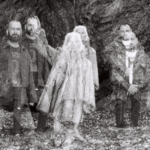
Main image: From Polka Dots (1976), Providence, Rhode Island, Francesca Woodman.

Possibly related to this:

  1. In conversation with Jeanette Winterson and Patricia Allmer Jeanette Winterson talks to Patricia Allmer, curator of female Surrealist show, Angels of Anarchy...
  2. Sisters of the revolution. Female surrealists on show in the Angels of Anarchy exhibition...

Filed Under: FeaturedPhoto Story

Tags:

RSSComments (0)

Trackback URL

Leave a Reply

  • Join our club
    Creative Tourist Boutique
  • Your top-to-bottom guide to Manchester
    The Manchester Cultural Calendar 2011
    • Boutique Weekender: February 2012

      Mark the start of spring with this very special, pick n’ mix weekend of art, music, dance and fashion

    • History lesson.

      Visiting Manchester? Want to find out more about what makes Manchester (and Mancunians) tick? Look no further than our potted guide to Manchester past and present. Susie Stubbs and Jonathan Schofield tell all.

    • Curiouser and curiouser.

      Susie Stubbs gets confused and amused at Tate Liverpool’s latest exhibition, Alice in Wonderland

  • Creative Tourist iPhone app
    Creative Tourist iPhone app
  • Manchester hotels
    Book your stay
  • A playful trip around the city
    Manchester Mini Explorer pack
  • Explore Manchester
    The Manchester Weekender 2012